
Alex Pretti Killing Sparks Statewide Outrage in Minnesota
Alex Pretti killing has ignited widespread outrage across Minnesota, intensifying already strained relations between state leaders and federal immigration authorities. The fatal shooting of Pretti, a 37-year-old U.S. citizen, Veteran Affairs ICU nurse, and respected healthcare worker, by a Border Patrol agent on Jan. 24 has become a flashpoint in the national debate over immigration enforcement, federal authority, and police accountability.
Minnesota officials, led by Governor Tim Walz, have vowed that the state will pursue accountability through its own justice system, even as federal agencies defend their actions. The killing has also prompted renewed protests, legal action, and congressional scrutiny, unfolding against the backdrop of another recent high-profile fatal shooting in the state.
Who Was Alex Pretti?
Alex J. Pretti was a registered nurse who worked in an intensive care unit caring for U.S. military veterans. Colleagues described him as dedicated, compassionate, and deeply committed to public service. He was also a U.S. citizen with no known criminal record, facts that have fueled public anger following his death.
Pretti’s role as a healthcare worker has resonated strongly with Minnesotans, many of whom see his killing as emblematic of broader systemic failures and excessive use of force by federal law enforcement.
What Happened on Jan. 24?
According to federal officials, Pretti confronted immigration authorities during a Border Patrol operation. Authorities allege he was carrying a firearm and intended to use it against law enforcement officers. However, videos captured by bystanders and witness accounts included in court filings do not show Pretti brandishing a weapon at the time he approached agents.
This discrepancy lies at the heart of the controversy surrounding the Alex Pretti killing. Civil rights advocates and state officials argue that the absence of visible threat raises serious questions about whether deadly force was justified.
Conflicting Accounts Fuel Public Distrust
Federal agencies have maintained that the agent involved acted in self-defense. Yet, the lack of clear visual evidence showing Pretti aiming or firing a weapon has intensified skepticism among the public.
Legal experts say such contradictions often complicate federal-state relations, particularly when investigations are conducted internally by federal agencies.
A State Already on Edge
The Alex Pretti killing occurred only weeks after another fatal incident involving federal law enforcement. In that case, Immigration and Customs Enforcement officers shot and killed Renee Nicole Good, also 37, sparking protests and demands for reform.
Together, the two killings have amplified tensions between Minnesota officials and the federal government, particularly regarding immigration enforcement tactics and the deployment of heavily armed agents in civilian areas.
Governor Tim Walz Vows Accountability
Governor Tim Walz addressed the shooting in a press conference just hours after Pretti’s death. Speaking forcefully, Walz promised that Minnesota would not remain silent.
“Minnesota’s justice system will have the last word on this,” Walz said. “It must have the last word.”
Walz criticized the Trump administration’s decision to deploy federal agents in military-style tactical gear, arguing that such actions escalate encounters and endanger civilians.
State vs. Federal Authority
The Alex Pretti killing has underscored the long-standing friction between state governments and federal immigration authorities. Minnesota leaders argue that federal agents operating within the state must still be subject to state laws and oversight.
Federal officials, however, contend that immigration enforcement falls squarely under federal jurisdiction, complicating efforts to hold agents accountable at the state level.
House Committee Demands Testimony
In response to the shooting, New York Republican Rep. Andrew Garbarino formally requested that the heads of Immigration and Customs Enforcement (ICE), Customs and Border Protection (CBP), and U.S. Citizenship and Immigration Services (USCIS) testify before the House Committee on Homeland Security.
The request builds on an earlier invitation for agency leaders to appear at a hearing focused on oversight of the Department of Homeland Security.
“Congress has an important responsibility to ensure the safety of law enforcement and the people they serve,” Garbarino said.
The hearing is expected to examine whether DHS agencies are using federal resources responsibly and lawfully.
Minnesota Attorney General Files Lawsuit
Minnesota Attorney General Keith Ellison announced late Saturday that he filed a lawsuit against federal officials to prevent the destruction of evidence related to the Alex Pretti killing.
Ellison’s legal action follows earlier concerns that state investigators were denied access to evidence in the Renee Nicole Good case.
“We will not allow evidence to disappear,” Ellison said. “Transparency is essential.”
National Guard Deployed Amid Protests
As protests intensified, Governor Walz authorized the deployment of Minnesota National Guard members to secure the site of the shooting and the Whipple Federal Building, a known immigration enforcement staging area.
According to officials, the Guard’s mission is to protect life, property, and the constitutional rights of protesters.
Army Maj. Andrea Tsuchiya emphasized that the Guard’s role is defensive, not enforcement-oriented.
Protesters Demand Justice
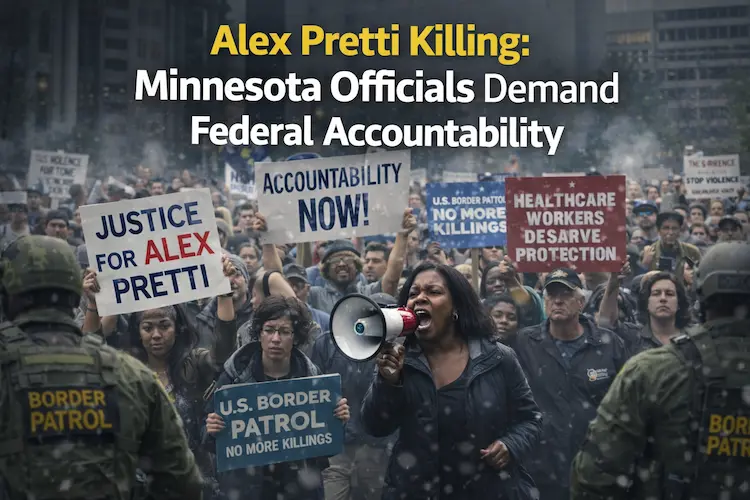
Demonstrations have drawn hundreds of people to downtown areas, with protesters calling for federal accountability, independent investigations, and reforms to immigration enforcement practices.
Signs reading “Justice for Alex Pretti” and “Healthcare Workers Deserve Protection” have become common sights at rallies.
Pam Bondi Responds With Demands
U.S. Attorney General Pam Bondi responded sharply to Minnesota’s actions, issuing a letter to Governor Walz demanding steps she said would restore “law and order” in the state.
Her demands included:
- Turning over voter registration records
- Repealing sanctuary city policies
- Supporting ICE and Border Patrol operations
Bondi argued that Minnesota’s resistance to federal immigration enforcement has contributed to instability.
Political Fallout Intensifies
Bondi’s letter has further polarized the debate. Supporters of Minnesota’s stance see the demands as federal overreach, while critics argue the state is obstructing lawful immigration enforcement.
Political analysts say the Alex Pretti killing could become a defining issue in upcoming elections, particularly as immigration remains a central national topic.
Calls for Independent Investigation
Civil rights groups, healthcare unions, and legal scholars are calling for an independent investigation into the shooting, citing concerns about transparency and conflicts of interest when federal agencies investigate themselves.
Several organizations have urged the Department of Justice’s Civil Rights Division to intervene.
Impact on Healthcare Community
Pretti’s death has deeply affected Minnesota’s healthcare community. Fellow nurses and hospital staff have organized vigils, emphasizing that healthcare workers should not fear deadly encounters while off duty.
Union leaders say the killing highlights broader safety concerns for essential workers.
Broader National Implications
Beyond Minnesota, the Alex Pretti killing has reignited national conversations about:
- Use of force by federal agents
- Oversight of immigration enforcement
- State authority versus federal power
Legal experts suggest the case could set precedents for how states respond to controversial federal actions within their borders.
What Happens Next?
Several investigations are now underway:
- Federal internal review
- Minnesota state lawsuit
- Congressional oversight hearings
The outcomes could reshape policies governing federal law enforcement operations.
Conclusion
The Alex Pretti killing has become more than a single tragic incident. It represents a collision of public safety, federal authority, state sovereignty, and civil rights. As Minnesota officials vow accountability and federal agencies defend their actions, the case continues to unfold with significant legal, political, and social consequences.
For many Minnesotans, the demand is simple: transparency, justice, and assurance that such a tragedy will not happen again.






Leave a Reply