
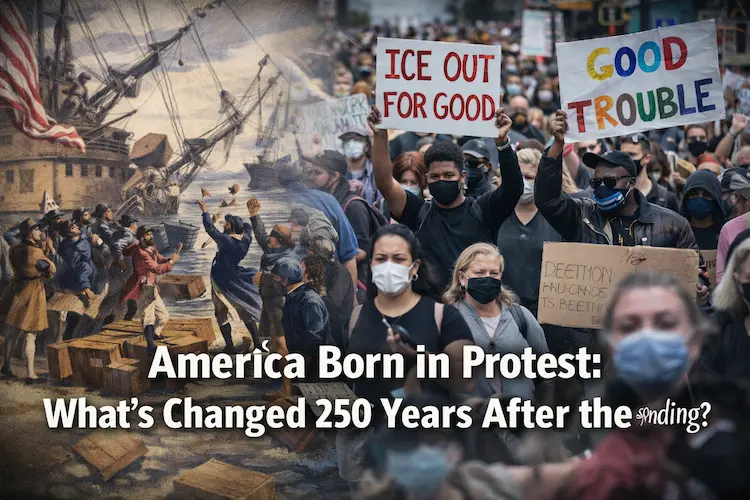
America born in protest is not a modern idea. From its very beginning in 1776, the United States has been shaped, challenged, and transformed by public dissent. Today’s demonstrations — including the recent Minneapolis protests — raise an enduring question: Is this moment different, or is it simply another chapter in a long American tradition?
Historians largely agree that protest is not a threat to American democracy but one of its defining features.
Protest at the Heart of America’s Founding
The nation’s founders didn’t call it protest. They called it “petitioning for redress.” Yet the Boston Tea Party, boycotts of British goods, and mass demonstrations against taxation without representation were unmistakably acts of public resistance.
“Protests have been pivotal to the progress of this country,” said Gloria Browne-Marshall, author of A Protest History of the United States. She describes demonstrations as “the human spirit pushing against insurmountable odds for something the status quo believes is unnecessary.”
From abolitionist movements to women’s suffrage, America born in protest has repeatedly relied on collective action to expand rights and redefine freedom.
From Civil Rights to “Good Trouble”
In the 20th century, protest took on new language and moral clarity.
Martin Luther King Jr. called it civil disobedience.
His protégé, Rep. John Lewis, famously described protest as “good trouble.”
Marches, sit-ins, and boycotts forced the nation to confront racial injustice and segregation — often amid fierce opposition from those in power who urged calm, patience, or silence.
Minneapolis Protests and the Modern Moment
That same tension is visible today.
Across the United States, tens of thousands of Americans have taken to the streets following the fatal shooting of Renee Nicole Good, a 37-year-old mother of three, who was killed on Jan. 7 during an Immigration and Customs Enforcement operation.
Demonstrators from major cities to small towns carried signs reading “ICE Out for Good” and chanted slogans demanding changes to immigration enforcement policies under the Trump administration.
The Minneapolis protests reflect how America born in protest continues to confront government power through public dissent.
Protest Moves Beyond the Streets
Modern protest is no longer limited to marches alone.
- Celebrities at the Golden Globe Awards wore pins reading “Be Good” and “ICE Out” to raise awareness
- Some Americans began boycotting companies such as UPS and Comcast over their contracts with ICE
- Social media amplified activism, spreading messages far beyond city streets
These tactics echo historical boycotts, from colonial resistance to the Montgomery bus boycott.
Government Pushback and Political Divisions
President Donald Trump has threatened to invoke the Insurrection Act in Minnesota, accusing demonstrators of attacking ICE agents.
Some Republicans have blamed Good’s killing on protest tactics, such as honking horns or alerting communities to ICE activity.
Homeland Security Secretary Kristi Noem labeled Good a “domestic terrorist.” Federal officials argue she attempted to run over an agent — a claim disputed by video footage that appears to show her attempting to flee.
Texas Rep. Roger Williams said such clashes occur because people “need to quit demonstrating.”
Has Anything Really Changed?
This language is not new.
Throughout American history, protesters have been told to stop, stay quiet, or trust institutions — even as the Constitution explicitly protects the right to assemble and challenge government authority.
From colonial revolutionaries to civil rights activists to today’s demonstrators, America born in protest has repeatedly faced resistance from leaders who view dissent as disorder rather than democracy in action.
America Born in Protest — Still
Two hundred fifty years later, the pattern remains familiar:
- Protest sparks discomfort
- Authorities respond with warnings
- History later recognizes dissent as necessary
Whether future generations see today’s Minneapolis protests as reckless or righteous, one truth remains unchanged:





Leave a Reply