
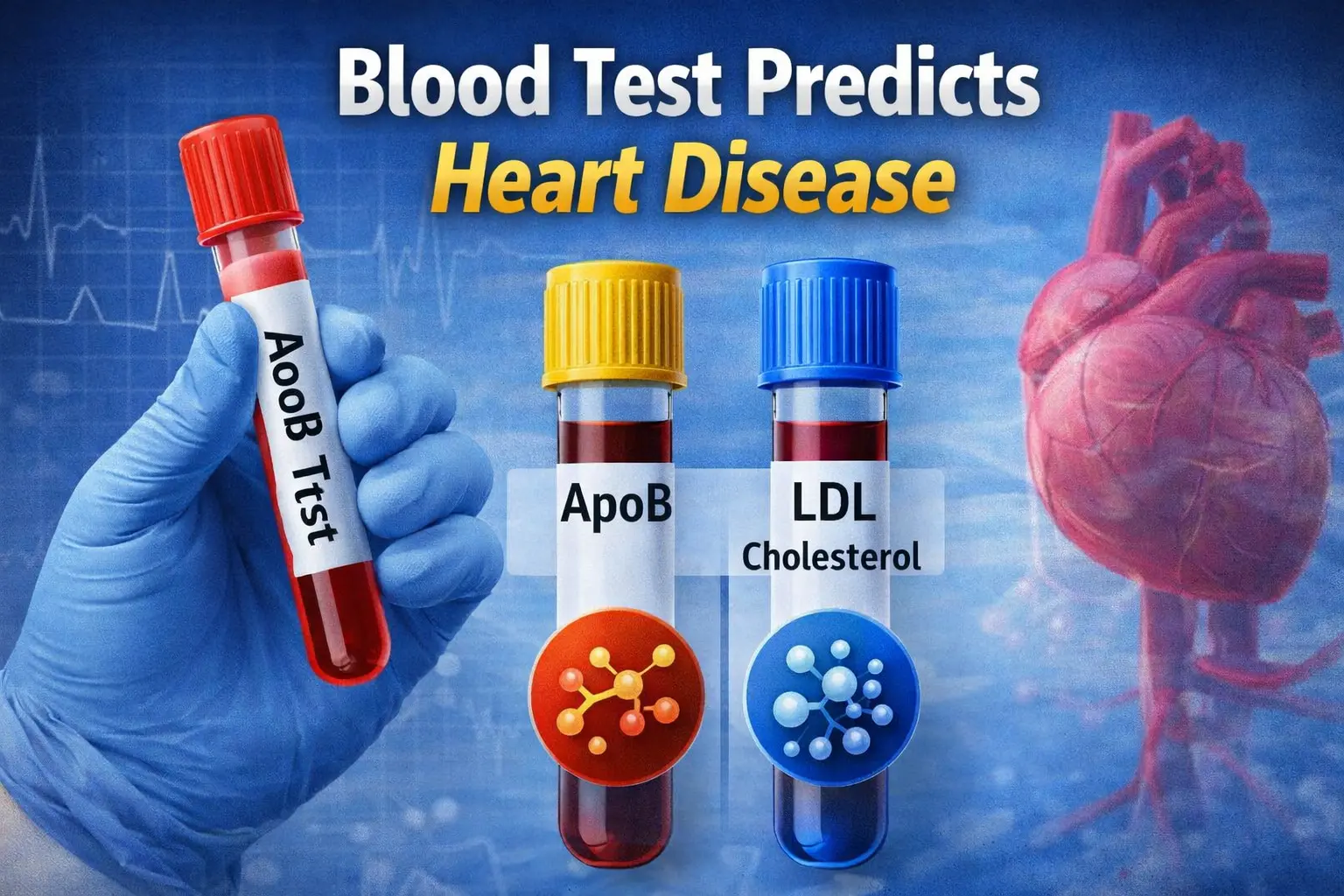
A revolutionary breakthrough in cardiovascular health shows that a blood test predicts heart disease more accurately than traditional methods. Researchers have identified the ApoB protein as a critical marker, potentially transforming how doctors assess cardiovascular risk.
For decades, LDL cholesterol has been the standard metric to evaluate heart disease risk. However, new studies suggest measuring ApoB, a protein linked to harmful cholesterol particles, may provide a clearer, more precise picture of heart health. This new blood test predicts heart disease in ways LDL alone cannot.
health related artical Cancer Treatment Timing Study 2026
Understanding ApoB and LDL
To understand how a blood test predicts heart disease, it’s essential to know the difference between ApoB and LDL cholesterol.
- LDL Cholesterol is often called “bad cholesterol.” High levels can lead to plaque buildup in arteries, increasing heart attack and stroke risk.
- ApoB Protein is a structural component of LDL particles. Measuring ApoB gives an exact count of potentially harmful cholesterol particles, providing a more accurate risk assessment than LDL levels alone.
In essence, while LDL measures cholesterol quantity, ApoB measures the number of risky particles in the bloodstream, making it a superior predictor in many cases.
Why Blood Test Predicts Heart Disease More Accurately
The reason blood test predicts heart disease more reliably with ApoB is simple: it evaluates the root cause of arterial plaque. LDL levels may sometimes underestimate risk, particularly in patients with normal cholesterol but high particle counts.
Studies show patients with elevated ApoB levels face a significantly higher risk of heart attacks and strokes than those with similar LDL levels. Therefore, integrating ApoB measurement into routine heart health checks could revolutionize cardiovascular prevention.
Who Should Consider This Blood Test
A blood test predicts heart disease is especially useful for:
- Individuals with family history of heart disease
- Patients with normal LDL but other risk factors (diabetes, obesity, hypertension)
- Middle-aged adults aiming for proactive health checks
- Anyone concerned about hidden cardiovascular risk
Doctors may recommend an ApoB test alongside traditional lipid panels to get a comprehensive assessment.
How the Test Works
The blood test predicts heart disease by measuring ApoB in the bloodstream. Here’s how it works:
- A standard blood draw collects the sample.
- Lab analysis measures the concentration of ApoB protein.
- Results indicate cardiovascular risk levels, often categorized as low, moderate, or high.
This process is quick, non-invasive, and highly accurate. Unlike traditional LDL tests, it identifies hidden risks that standard cholesterol tests may miss.
Implications for Heart Health
With a blood test predicts heart disease, preventive strategies can be tailored more precisely:
- Lifestyle changes: diet, exercise, and weight management can be targeted based on ApoB results.
- Medication adjustments: statins or other lipid-lowering drugs may be prescribed more effectively.
- Monitoring frequency: patients with high ApoB levels may require closer follow-up to prevent cardiovascular events.
This personalized approach can save lives by identifying high-risk individuals early.
Diet and Lifestyle to Lower ApoB Levels
A blood test predicts heart disease can guide actionable lifestyle modifications:
- Heart-healthy diet: rich in fruits, vegetables, whole grains, and lean proteins
- Regular physical activity: at least 150 minutes of moderate exercise weekly
- Weight management: maintaining a healthy BMI reduces ApoB levels
- Smoking cessation: lowers cardiovascular risk significantly
- Alcohol moderation: excessive consumption increases heart disease risk
Medical Treatments Based on ApoB Levels
For patients with elevated ApoB, a blood test predicts heart disease may lead to targeted medical interventions:
- Statins: lower LDL and ApoB particles
- PCSK9 inhibitors: for patients who don’t respond to traditional medications
- Novel therapies: new drugs under study focus on reducing ApoB specifically
Doctors can personalize treatment plans based on exact ApoB measurements, improving outcomes.
Limitations and Considerations
While a blood test predicts heart disease offers superior accuracy, it’s not a complete solution:
- It should complement, not replace, standard cardiovascular assessments
- Cost and insurance coverage may vary
- Interpretation requires professional medical guidance
Still, for many patients, the benefits of ApoB testing outweigh these limitations.
The Future of Heart Disease Prediction
The development of blood test predicts heart disease marks a shift toward precision medicine in cardiology. Widespread adoption of ApoB testing could:
- Reduce heart attack rates through early intervention
- Customize prevention strategies for high-risk patients
- Empower individuals to take proactive measures to protect their heart
This innovation represents a major leap forward in cardiovascular health management.
Conclusion
The research proving a blood test predicts heart disease demonstrates the growing importance of ApoB measurement in heart health. By offering more precise risk assessment than LDL cholesterol alone, this test allows for targeted interventions, personalized treatment, and better prevention strategies.
For Americans concerned about cardiovascular risk, understanding and using this advanced blood test could be a life-saving decision.







Leave a Reply