
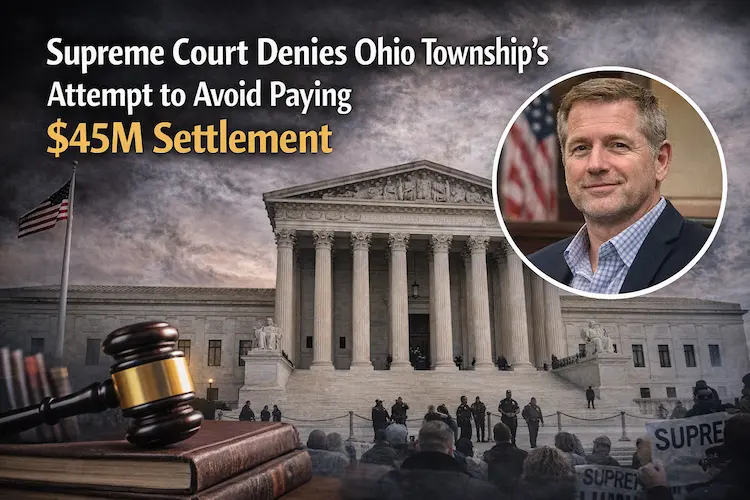
Dean Gillispie $45 Million Settlement Final After Supreme Court Denial
Dean Gillispie $45 million settlement has officially become final after the U.S. Supreme Court denied an attempt by an Ohio township to avoid paying the massive civil judgment. The landmark decision closes years of legal battles stemming from one of Ohio’s most disturbing wrongful conviction cases and sends a powerful message about accountability in law enforcement.
The ruling ensures that Dean Gillispie, a man who spent decades behind bars for crimes he did not commit, will finally receive compensation for the life he lost to injustice.
Supreme Court Rejects Ohio Township Appeal
The U.S. Supreme Court declined to hear Miami Township’s appeal, effectively upholding lower court rulings that affirmed the Dean Gillispie $45 million settlement. By refusing to intervene, the high court left intact a federal jury’s finding that Gillispie’s constitutional rights were violated by a former township detective.
Legal experts say the Supreme Court’s decision underscores the seriousness of civil rights violations and signals that local governments cannot escape responsibility through prolonged legal maneuvering.
Who Is Dean Gillispie?
Dean Gillispie, now 60, is a resident of Fairborn, Ohio, whose life was irrevocably altered by a wrongful conviction in 1991. He was accused of the rape and kidnapping of twin sisters and a separate sexual assault on another woman.
Despite the lack of physical or biological evidence, Gillispie was convicted and sentenced to decades in prison.
For years, he maintained his innocence.
Evidence Withheld and Rights Violated
At the center of the case was former Miami Township detective Matthew Scott Moore, who federal jurors later determined had violated Gillispie’s civil rights.
According to court findings:
- Exculpatory evidence was hidden from the defense
- Improper and suggestive lineup procedures were used
- Critical investigative failures were concealed
These actions ultimately led to Gillispie’s wrongful imprisonment — the foundation for the Dean Gillispie $45 million settlement.
No DNA Ever Linked Gillispie to the Crimes
One of the most troubling aspects of the case is that no biological evidence ever connected Dean Gillispie to the crimes.
Independent reviews later confirmed that DNA testing excluded Gillispie as a suspect, raising serious questions about how the original conviction was obtained.
Release, Exoneration, and Vindication
After spending 20 years in prison:
- Gillispie was released in 2011
- Officially exonerated in 2017
- Declared wrongfully imprisoned in 2021
These milestones paved the way for the civil lawsuit that resulted in the Dean Gillispie $45 million settlement.
The $45 Million Jury Verdict Explained
In 2022, a federal jury awarded Gillispie $45 million in damages, one of the largest wrongful conviction settlements in Ohio history.
The verdict included:
- Compensation for decades of lost freedom
- Emotional and psychological trauma
- Reputational harm
- Lost opportunities and income
Since the verdict, the unpaid judgment has continued to accrue interest.
Ohio Township Claims Bankruptcy Risk
Miami Township argued that paying the Dean Gillispie $45 million settlement could financially cripple the local government and potentially force it into bankruptcy.
The township sought relief through appeals, supported by:
- Ohio Township Association
- Ohio Chamber of Commerce
Both groups warned that large civil judgments could destabilize municipalities.
Courts Reject Financial Hardship Argument
Despite those arguments, both the Sixth Circuit Court of Appeals and the U.S. Supreme Court rejected the township’s claims.
Judges ruled that:
- Financial difficulty does not excuse constitutional violations
- Victims of injustice deserve full compensation
- Government entities must be held accountable
Attorney: Township Prolonged Gillispie’s Suffering
Gillispie’s attorney, David B. Owens, strongly criticized the township’s legal tactics.
In a statement, Owens said:
“Miami Township prolonged Dean Gillispie’s suffering through dubious legal maneuvers and absurd appeals.”
He emphasized that justice delayed is justice denied.
Township Response After Supreme Court Decision
Miami Township released a statement saying it would continue exploring ways to resolve the judgment while preserving essential services.
However, legal analysts note that the Supreme Court’s denial leaves the township with few remaining options.
Art as Survival: Gillispie’s Life in Prison
While incarcerated, Dean Gillispie turned to art as a means of survival.
His artwork:
- Reflected pain, isolation, and hope
- Gained national recognition
- Was featured at the Museum of Modern Art (MoMA) in New York
In 2020, his work appeared in “Marking Time: Art in the Age of Mass Incarceration.”
Why the Dean Gillispie $45 Million Settlement Matters
The Dean Gillispie $45 million settlement is more than financial compensation — it represents:
- Accountability for law enforcement misconduct
- A warning against evidence suppression
- Validation for the wrongfully convicted
Civil rights advocates say the case sets a national precedent.
Impact on Law Enforcement Nationwide
Legal experts believe the ruling will:
- Encourage transparency in investigations
- Increase oversight of police procedures
- Strengthen civil rights litigation
The settlement sends a clear message: constitutional violations carry real consequences.
Public Reaction and Advocacy Groups
Wrongful conviction advocacy groups, including the Ohio Innocence Project, praised the Supreme Court decision.
They emphasized that the case highlights systemic flaws that still exist in the criminal justice system.
A Landmark Victory for Justice
For Dean Gillispie, the Supreme Court’s action brings long-awaited closure.
After losing decades of his life, the Dean Gillispie $45 million settlement stands as a powerful symbol of resilience, truth, and accountability.
Conclusion
The Supreme Court’s refusal to intervene ensures that the Dean Gillispie $45 million settlement remains intact — a historic judgment that affirms the importance of justice, even when it comes decades late.
Gillispie’s story serves as a reminder that wrongful convictions are not abstract legal errors, but human tragedies that demand accountability.






Leave a Reply