
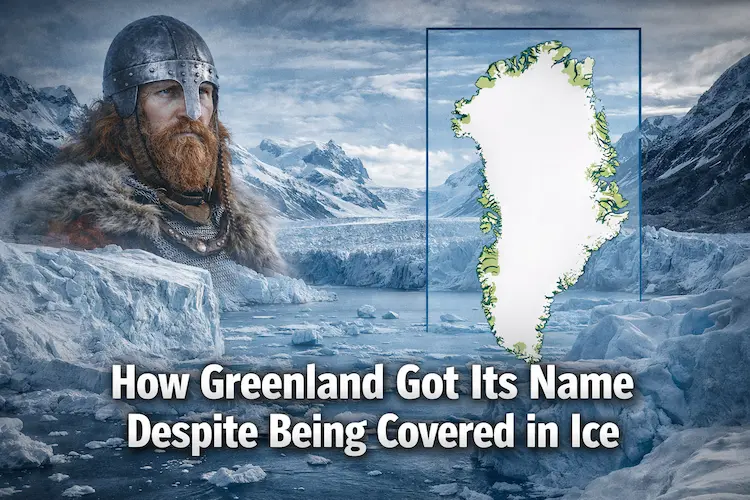
At first glance, Greenland’s name seems misleading. The massive island in the North Atlantic is largely covered by ice, snow, and glaciers, making the name “Greenland” sound almost ironic. Yet the story behind how Greenland got its name is a fascinating mix of Viking strategy, early climate shifts, and clever marketing that dates back more than a thousand years.
Today, Greenland is once again in the global spotlight, as political discussions and climate research bring renewed attention to the world’s largest island. But long before modern headlines, the name itself was already sparking curiosity.
Greenland Is Mostly Ice, Not Green
Despite what its name suggests, Greenland is anything but green for most of the year. Around 80% of the island is covered by a massive ice sheet, one that has existed for thousands of years. This ice sheet is so large that it plays a critical role in global sea levels and climate systems.
Even now, only the coastal edges of Greenland support vegetation, while the interior remains frozen. So why would anyone name such a place “Greenland”?
Erik the Red and a Clever Marketing Strategy
Why Is Greenland Called Greenland?
The answer lies with Erik the Red, a Viking explorer who discovered Greenland around the late 10th century. According to Icelandic sagas—ancient historical records preserved for over a thousand years—Erik deliberately chose the name “Greenland” to attract settlers.
Erik believed people would be more willing to move to a place with a pleasant-sounding name.
In other words, Greenland was one of history’s earliest examples of branding and marketing. Calling it “Iceland 2.0” probably wouldn’t have convinced many families to pack up and move.
This marketing tactic worked. Norse settlers arrived and established small farming communities along Greenland’s relatively milder coastal regions.
Greenland Was Slightly Greener in the Past
The Medieval Warm Period Explained
Another important part of the Greenland naming story is climate history. When Erik the Red arrived, the planet was experiencing the Medieval Warm Period (roughly 900–1300 AD). During this time, temperatures in parts of the North Atlantic were slightly warmer than average.
Was Greenland Ever Truly Green?
Not entirely—but parts of it were greener than today. Some coastal regions supported grasslands suitable for farming and livestock. However, even at its warmest, most of Greenland remained ice-covered.
So while the name “Greenland” wasn’t completely accurate, it also wasn’t pure fiction.
Climate Change Is Making Greenland Greener Again
Modern Research and Ice Sheet Melting
Fast forward to today, and Greenland is slowly living up to its name once more—this time for very different reasons. A 2025 scientific study revealed that Greenland’s ice sheet is melting rapidly due to global warming, exposing land that is increasingly being replaced by vegetation.
Earth scientists report that some areas are becoming green again for the first time since the Vikings lived there nearly 1,000 years ago.
What This Means for the Future
While more greenery might sound positive, the melting ice poses serious global risks, including rising sea levels and disrupted weather patterns. Greenland’s changing landscape is a powerful indicator of how climate change is reshaping the planet.
A Name That Tells a Story
The history of Greenland’s name combines Viking ambition, early climate change, and strategic persuasion. What began as a clever marketing move has become one of geography’s most intriguing contradictions.
Ironically, as Greenland warms and ice retreats, the island may slowly begin to resemble the name Erik the Red gave it centuries ago—though at a cost the Vikings could never have imagined.






Leave a Reply