
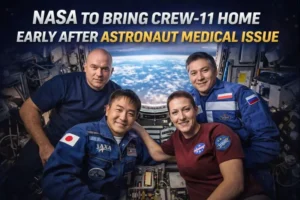
NASA has announced plans to bring the Crew-11 astronauts back to Earth earlier than scheduled after one crew member aboard the International Space Station (ISS) experienced an undisclosed medical issue.
NASA did not identify the astronaut or share details about the medical condition, citing privacy concerns. Officials confirmed that the crew member is currently stable, but the decision to return early was made as a precaution.
“This was a serious medical condition, which is why we’re pursuing this path,” NASA Administrator Jared Isaacman said during a news conference on Thursday, January 8.
First Medical Evacuation in ISS History
According to Dr. James Polk, NASA’s chief health and medical officer, this will be the first medical evacuation in the 25-year history of the International Space Station.
NASA officials emphasized that this is not an emergency deorbit, but rather a careful decision to ensure proper medical diagnosis and treatment on Earth.
“The capability to fully diagnose and treat this condition does not exist on the ISS,” Isaacman explained.
At Least 2 Dead After Shooting Outside Salt Lake City Church

Crew-11 Astronauts Returning to Earth
In the coming days, the SpaceX Dragon Endeavour spacecraft will depart the ISS carrying all four Crew-11 members:
-
Mike Fincke (NASA)
-
Zena Cardman (NASA)
-
Kimiya Yui (Japan Aerospace Exploration Agency)
-
Oleg Platonov (Roscosmos)
NASA expects to share more details about the undocking and splashdown timeline within the next 48 hours.
Mission Background
Crew-11 launched to low-Earth orbit on August 1 from NASA’s Kennedy Space Center aboard a SpaceX Falcon 9 rocket.
Two astronauts, Fincke and Cardman, were scheduled to perform a 6½-hour spacewalk to upgrade power systems and prepare for future solar arrays. NASA confirmed that the medical issue was completely unrelated to spacewalk preparations or onboard operations.
NASA Taking a Cautious Approach
Dr. Polk said NASA is erring on the side of caution by returning the crew early, ensuring the affected astronaut receives full medical care on Earth.
The mission’s early conclusion highlights NASA’s commitment to crew safety and health, even during long-term space missions.







Leave a Reply