
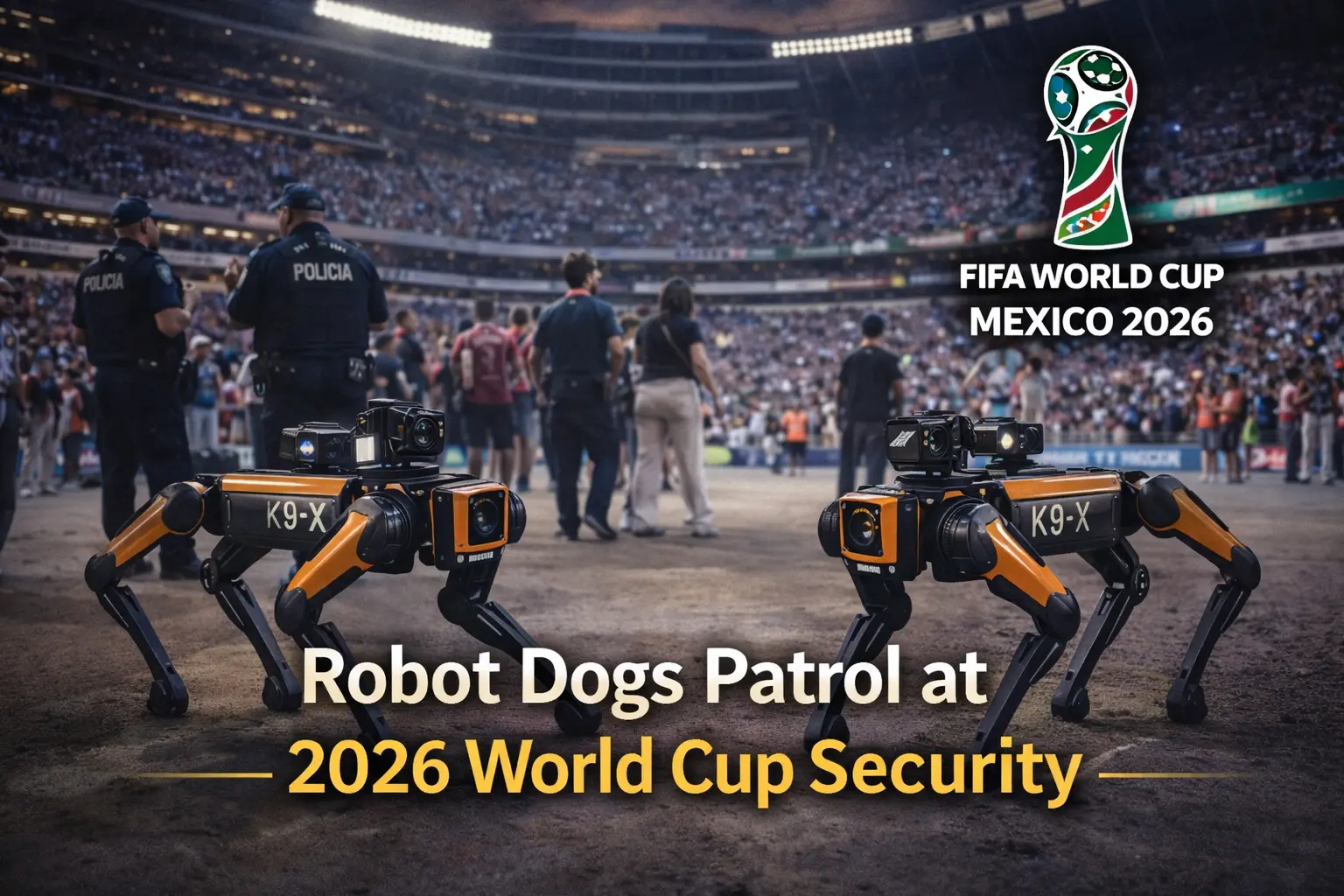
Robot Dogs Patrol at 2026 World Cup Security marks a new era of tech‑driven safety at one of the world’s biggest sporting events. Mexican authorities in Guadalupe, Nuevo León recently unveiled four advanced K9‑X robot dogs that will support police patrols at BBVA Stadium — one of the three Mexican host venues for the 2026 FIFA World Cup.
These robotic units are designed to act as first responders and surveillance assistants, helping push the boundaries of event security while reducing risks for human officers.
The Robots of CES 2026 Smart Helpers, Lawn Mowers, and Digital Pets Take Center Stage

1. What Are the Robot Dogs?
The new security devices, part of the K9‑X unit, are quadrupedal robots equipped with high‑resolution video cameras, night vision, and audio communication systems.
Though not armed, these robot dogs can detect unusual behavior, identify suspicious objects, and relay real‑time video to law enforcement officers, acting as “eyes and ears” in crowd‑heavy locations.
Operators control the robots much like drones or video game systems and can issue instructions through speakers if needed.
2. Why Robot Dogs Are Being Used
Security officials in Guadalupe explain that the robot dogs are part of a broader strategy to enhance safety during the World Cup, especially in high‑traffic areas around BBVA Stadium.
Guadalupe Mayor Héctor García said the K9‑X units can enter potentially dangerous situations before police, helping protect officers and provide information during early stages of risky encounters.
This technology is seen as a way to improve response times and reduce the likelihood of harm to the public and to security personnel.
3. How They Operate
These robot dogs do not make autonomous decisions. Instead, trained operators remotely control them, guiding them through entrances, stadium corridors, and perimeter areas — just like a surveillance drone.
Each robot can transmit live video, scan environments with night vision, and broadcast instructions if needed, helping officers gauge situations before committing human resources.
4. First Real‑World Deployment
The K9‑X units have already logged real patrol time during a Club de Futbol Monterrey match, patrolling the BBVA Stadium perimeter and crowd areas.
This early deployment served as a test run ahead of the World Cup, offering valuable insights into how the robots function in live events and how operators can best use them in large crowds.

5. Part of a Broader Security Plan
Robot dogs are just one element of Guadalupe’s overall strategy for 2026 World Cup security. Local authorities also plan to use advanced surveillance drones and anti‑drone systems to monitor the skies and ground around World Cup stadiums.
This layered approach aims to create a safe environment for millions of fans expected to attend matches across Mexico, Canada, and the United States.
6. Safety, Not Force
Importantly, the robot dogs are non‑weaponized. Their focus is on surveillance, threat detection, and early intervention — not force.
By entering potentially risky situations before human officers, they help reduce exposure to dangerous environments, such as fights or disturbances involving intoxicated individuals.
This capability allows law enforcement to gather intelligence and evaluate risk without immediate human involvement.
7. What It Means for Future Events
The deployment of robot dogs at the 2026 World Cup reflects a growing trend in using robotics and automation for large‑scale event security.
With millions of spectators expected and global media coverage at stake, host nations are integrating cutting‑edge technologies — from robotic patrol units to counter‑drone systems — to enhance public safety and emergency response.
This could set a precedent for future mega‑events, including Olympics, global summits, and other international tournaments.
South Korea’s Battery Makers Eye Robot Market as EVs Slump

Frequently Asked Questions
Q1: What are K9‑X robot dogs?
They are quadrupedal robotic units equipped with cameras, night vision, and communication systems to assist police in public safety during events like the 2026 World Cup.
Q2: Are these robot dogs armed?
No — they are non‑weaponized and focused on surveillance and sending real‑time data to officers.
Q3: Where will the robot dogs operate?
They will patrol around BBVA Stadium in Guadalupe, Mexico, one of the three host venues for the 2026 World Cup.
Q4: Why use robots instead of regular police?
Robot dogs reduce risks to human officers by entering potentially dangerous or high‑risk areas first.
Q5: Will this technology be used in other mega events?
The 2026 World Cup deployment may set a trend for future large‑scale events, integrating robotics for safety and surveillance.
Conclusion
Robot Dogs Patrol at 2026 World Cup Security represents an innovative step in using robotics to protect fans, officers, and the general public during one of the world’s most anticipated sporting events. By combining advanced surveillance technology with experienced law enforcement, organizers are raising the bar for event security in the 21st century.






Leave a Reply