
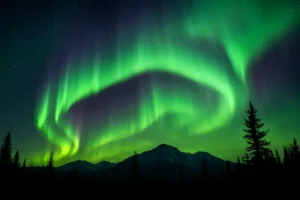
Scintillating Auroras Dazzle in the Night Sky Over North America
Brilliant streaks of green, purple, and red illuminated the skies across North America on November 11, reaching as far south as Florida. The dazzling spectacle was triggered by a powerful geomagnetic storm entering Earth’s atmosphere, the Space Weather Prediction Center (SWPC) confirmed.
The event, rated G4 (severe), painted the night sky with colors rarely seen at such low latitudes. Officials warned the storm could temporarily impact power grids, GPS accuracy, and communication systems into November 12, while also promising another night of breathtaking auroral activity.
What Caused the Dazzling Auroras?
The mesmerizing lights were caused by coronal mass ejections (CMEs) — massive bursts of solar material and magnetic fields ejected from the sun. These CMEs, which erupted on November 9 and 10, traveled through space and reached Earth’s atmosphere on November 11, according to the SWPC in Boulder, Colorado.
At 8:20 p.m. EST, the storm reached its peak intensity. Shawn Dahl, a senior forecaster, noted that multiple CMEs struck Earth, with one more expected to arrive by midday on November 12. He described the first two as “profoundly stronger than anticipated,” while the third was expected to be the most energetic.
How Geomagnetic Storms Affect Earth
When solar particles collide with Earth’s magnetosphere, they trigger geomagnetic storms — powerful interactions that can impact satellites, aviation, and precision GPS systems. Dahl explained that GPS devices requiring inch-level accuracy could experience significant disruptions.
Authorities from space launch operations, utility grids, and even the White House were briefed on potential impacts from the ongoing solar activity.
Why the Northern Lights Glow with Different Colors
According to the University Corporation for Atmospheric Research, the stunning colors of auroras are created by solar particles interacting with different gases in the atmosphere:
- Oxygen emits green and red light.
- Nitrogen produces blue and purple hues.
These interactions occur between 60 and 250 miles above Earth, resulting in nature’s most beautiful light display — the Aurora Borealis.
When and Where to See the Next Auroras
With solar activity expected to increase as the sun approaches its 11-year peak cycle, experts predict that more aurora sightings could appear in the coming months. Those in northern regions — from Montana to Maine, and even parts of the Midwest — should keep an eye on space weather alerts for another chance to witness this celestial wonder.







Leave a Reply