
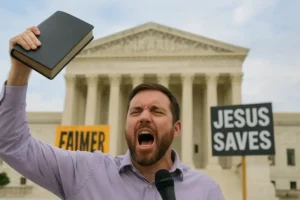
WASHINGTON – The city amphitheater in a suburb of Jackson, Mississippi, attracts thousands of concertgoers every year. But it has also become a platform for evangelical preacher Gabriel Olivier and his group, who regularly gather there to spread their religious message.
According to officials in Brandon, Mississippi, the group’s actions crossed the line from peaceful preaching to public disruption. Authorities say Olivier and others used a loudspeaker to shout insults such as “whores” and “Jezebels”, while displaying large graphic signs depicting aborted fetuses. These actions, they claim, disturbed the peace and made the environment unsafe and uncomfortable for the public.
As a result, Olivier was arrested for refusing to remain in the city’s designated protest area, a space specifically set aside for demonstrations and public expression.
Is This a Religious Freedom Case?
Gabriel Olivier argues that the city violated his First Amendment right to freely exercise his religion. He claims that being restricted to a designated area limits his ability to spread his faith and that such restrictions make religious liberty meaningless.
Olivier is now asking the U.S. Supreme Court to allow him to sue the city for violating his constitutional rights.
However, city officials strongly disagree. They argue that:
The rules apply to all individuals and groups, not just religious organizations
Olivier broke a neutral and lawful city ordinance
He failed to challenge his conviction in state court before trying to take the case to federal court
In a written statement, the city’s attorneys said:
> “Olivier wants this case to be about religious liberty. It’s not.”
What Happens If the Supreme Court Takes His Case?
If the Supreme Court allows Olivier’s lawsuit to proceed, it could:
Set a precedent allowing people to sue cities after pleading guilty to local offenses
Reduce the power of cities to control public demonstrations
Expand the boundaries of religious expression in public spaces
If the court rejects his appeal, it will reinforce local governments’ authority to regulate protests and maintain public order.
Final Thoughts
This case has become more than one man’s legal battle. It is now a national conversation about the balance between religious freedom and public safety. The Supreme Court’s ruling could reshape how American cities manage protests and religious demonstrations in the future.
All eyes are on the court as it prepares to hear arguments on December 3.




Leave a Reply