
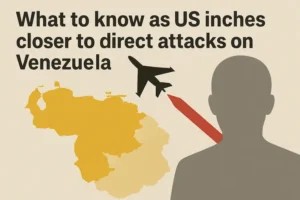
The United States and Venezuela are once again at the center of growing political and military tension. In a recent social media post, former President Donald Trump warned that airspace surrounding Venezuela should be considered unsafe, a statement that quickly drew global attention. Venezuelan officials strongly condemned the message, calling it a violation of international norms and an unacceptable threat to their sovereignty.
Over the past few months, the situation between Washington and Caracas has intensified. U.S. officials have repeatedly accused the Venezuelan government, led by President Nicolás Maduro, of being involved in illegal drug trafficking and supporting terrorism. Venezuela has firmly rejected these claims, labeling them as politically motivated.
Reports indicate that American forces have carried out operations near Venezuela’s waters, targeting vessels suspected of involvement in drug smuggling. These actions, though not officially admitted as direct military strikes, have once again raised fears of a broader conflict in the region.
Venezuela, a country with a population of more than 31 million people and a land area larger than Texas, has already been struggling with a long-running economic and humanitarian crisis. Any direct confrontation could potentially destabilize the entire South American region and cause further displacement of civilians.
International organizations and global leaders are urging restraint and encouraging diplomatic solutions. Analysts believe that sanctions, political pressure, and dialogue remain more realistic options than a full-scale military intervention.
As the situation develops, the world continues to watch closely, hoping that diplomacy will prevail over conflict.




Leave a Reply